VERSION HISTORY
LIRA-FEM
- Mass redistribution
- Damping ratio
- Seismic isolators
- Pushover Analysis
- Finite element "Joint"
- New types of perfectly rigid body (PRB)
- Nonlinear behaviour of soil
- New type of force
- Nonlinear custom cross-sections
- Accounting for orthotropy
- Analysis parameters
- Analysis of reactions
- Stresses and forces
- Dynamics
- Nonlinearity
- Finite elements
- Calculation and Performance
Stresses and forces
-
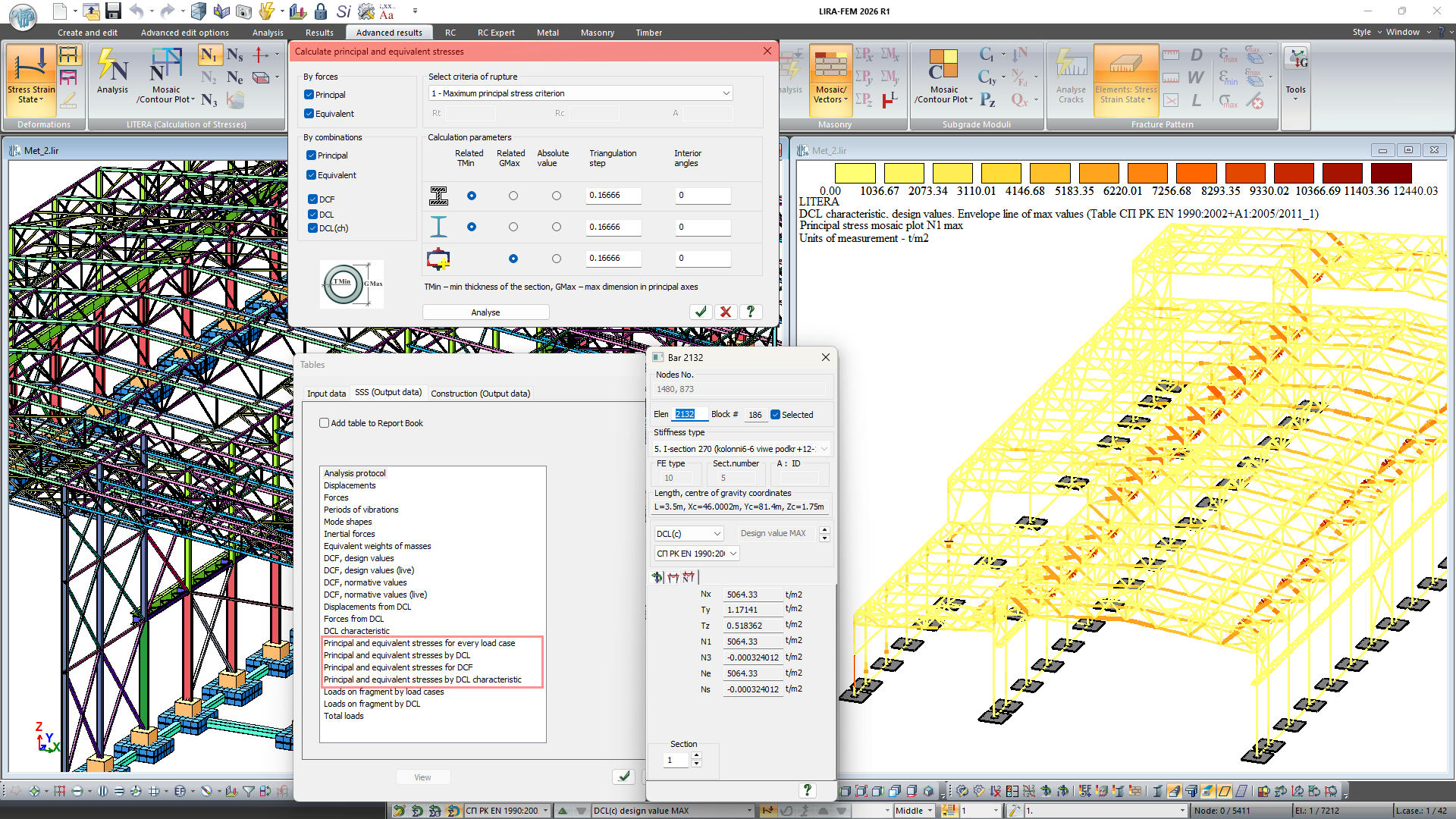
The LITERA system has been significantly expanded and modified. It is designed to compute principal and equivalent stresses in finite elements based on forces from individual load cases, as well as from design combinations — DCL, DCL(c), and DCF.
Previously, calculations were performed for solid elements, plates, and a limited set of standard section types: bar, T-section, I-beam, channel, etc. Now, principal and equivalent stresses are calculated for solid elements, plates, and also in cross-sections of bars for all section types — both standard steel and monomaterial sections of arbitrary shape.
The cross-section is automatically divided into finite elements. Flexible adjustment of the division step is provided: in absolute values or relative — as a fraction of the minimum element thickness tmin or of the maximum dimension along principal axes. Additionally, the option to set an exclusion radius in internal corners of the section has been implemented to avoid searching for critical points in stress concentration zones.
Implemented calculation of principal and equivalent stresses in finite elements based on defining design load combinations.
Integrated the Pisarenko–Lebedev strength theory, intended for the calculation of nonhomogeneous materials. It provides a more accurate assessment of the stress state of materials with different strength limits in tension and compression.
Calculation results are available in both tabular and graphical form.
-
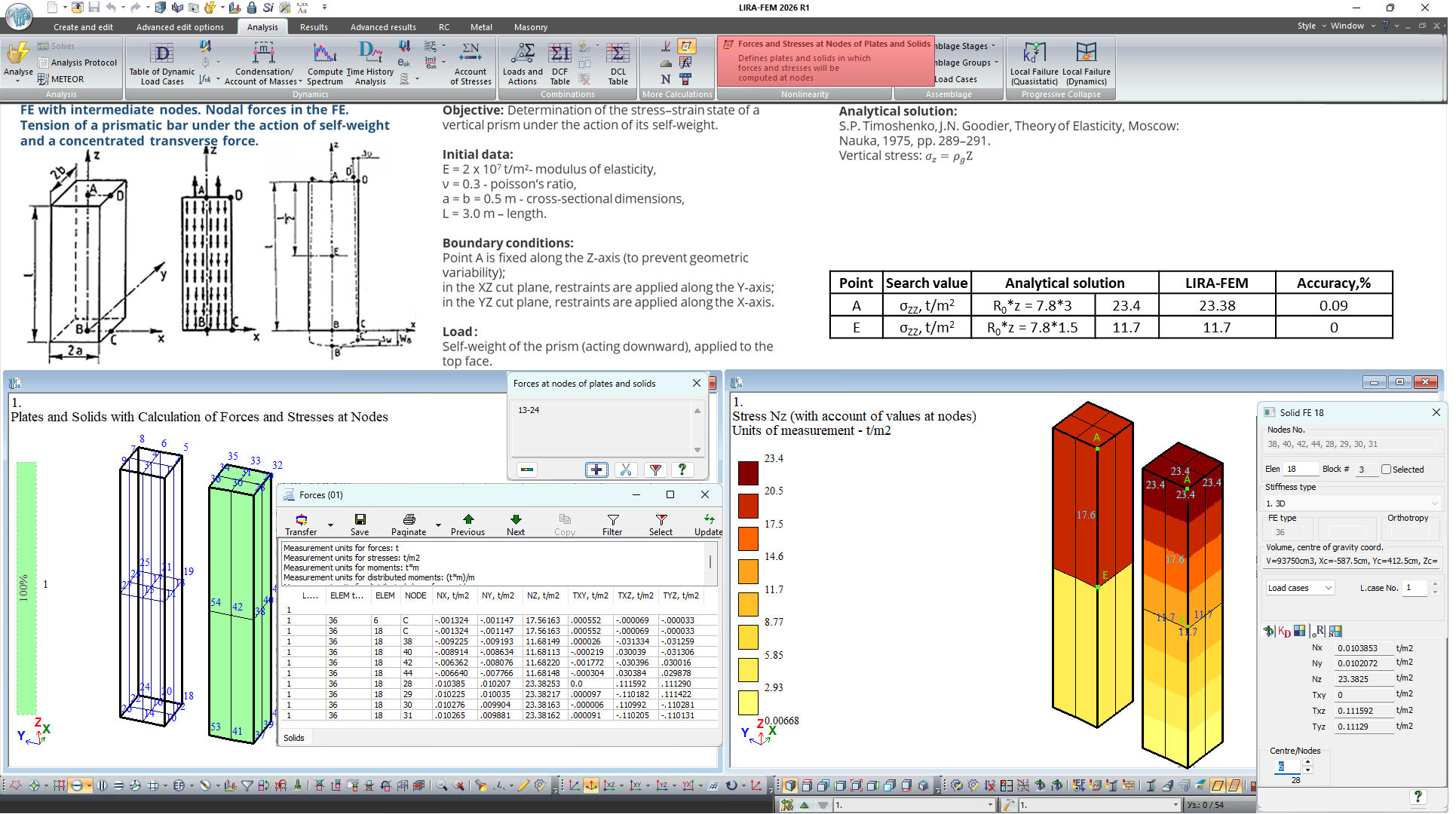
For linear solid FEs, stress calculation at nodes has been implemented. Results are available in both tabular and graphical form. Using this option increases accuracy of stress determination when calculating on a coarse mesh of solid elements, as well as when integrating forces in target plates of plate FEs.
Important note: for calculation of solid FE arrays on a coarse mesh, it is necessary to enable the option of forming additional nodes on edges in calculation parameters. This applies to plate and solid FEs and switches the calculation from classical FEs to high-precision ones.
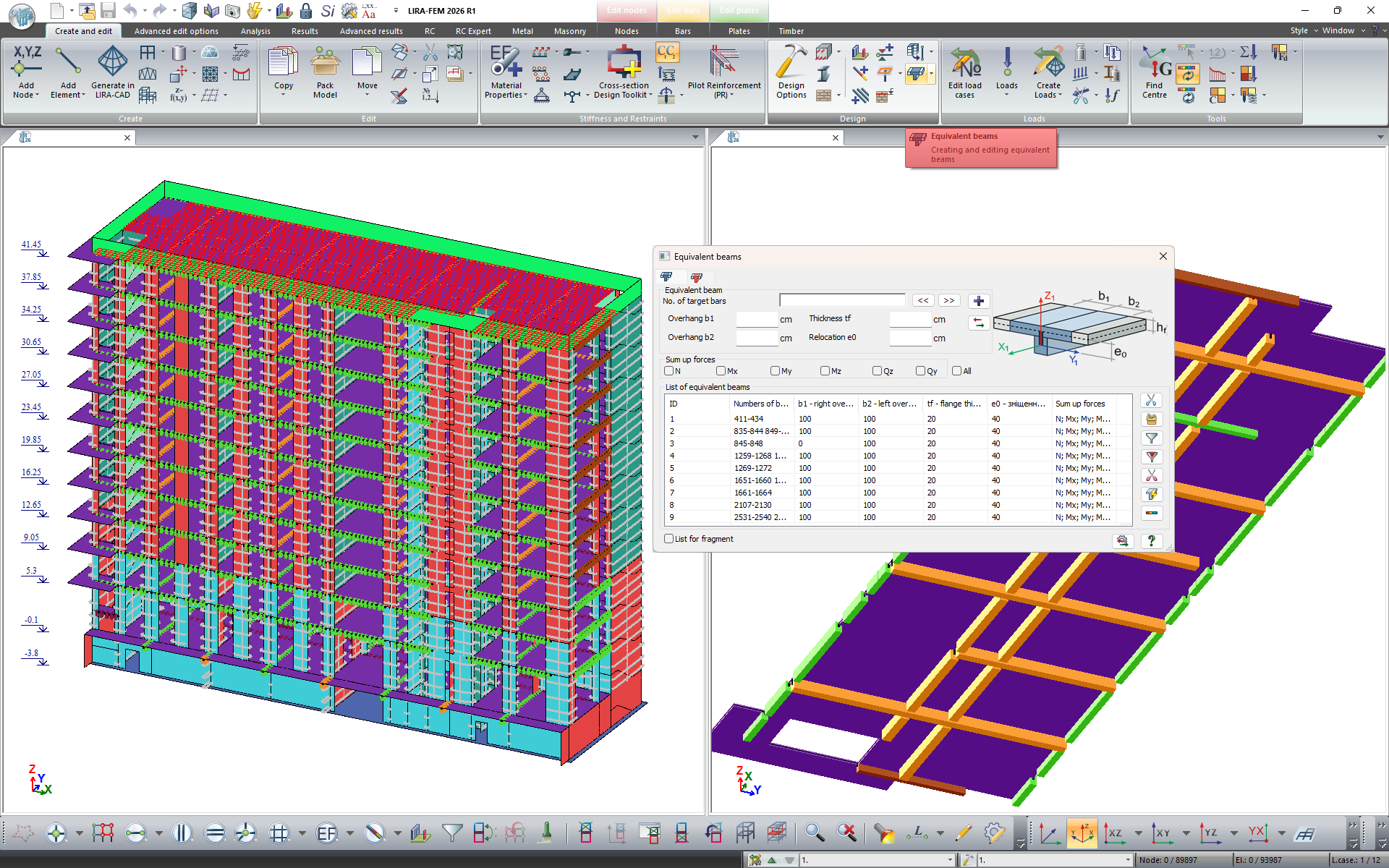
- Implemented calculation of forces in support and tie beams, ribs, and T-beams considering overhang width. Forces are determined according to the model of joint beam–slab action, taking into account the geometry of the formed section, which allows more accurate consideration of element stiffness, distribution of internal forces, and structural deformations.