VERSION HISTORY
LIRA-FEM
- Mass redistribution
- Damping ratio
- Seismic isolators
- Pushover Analysis
- Finite element "Joint"
- New types of perfectly rigid body (PRB)
- Nonlinear behaviour of soil
- New type of force
- Nonlinear custom cross-sections
- Accounting for orthotropy
- Analysis parameters
- Analysis of reactions
- Stresses and forces
- Dynamics
- Nonlinearity
- Finite elements
- Calculation and Performance
Dynamics
-
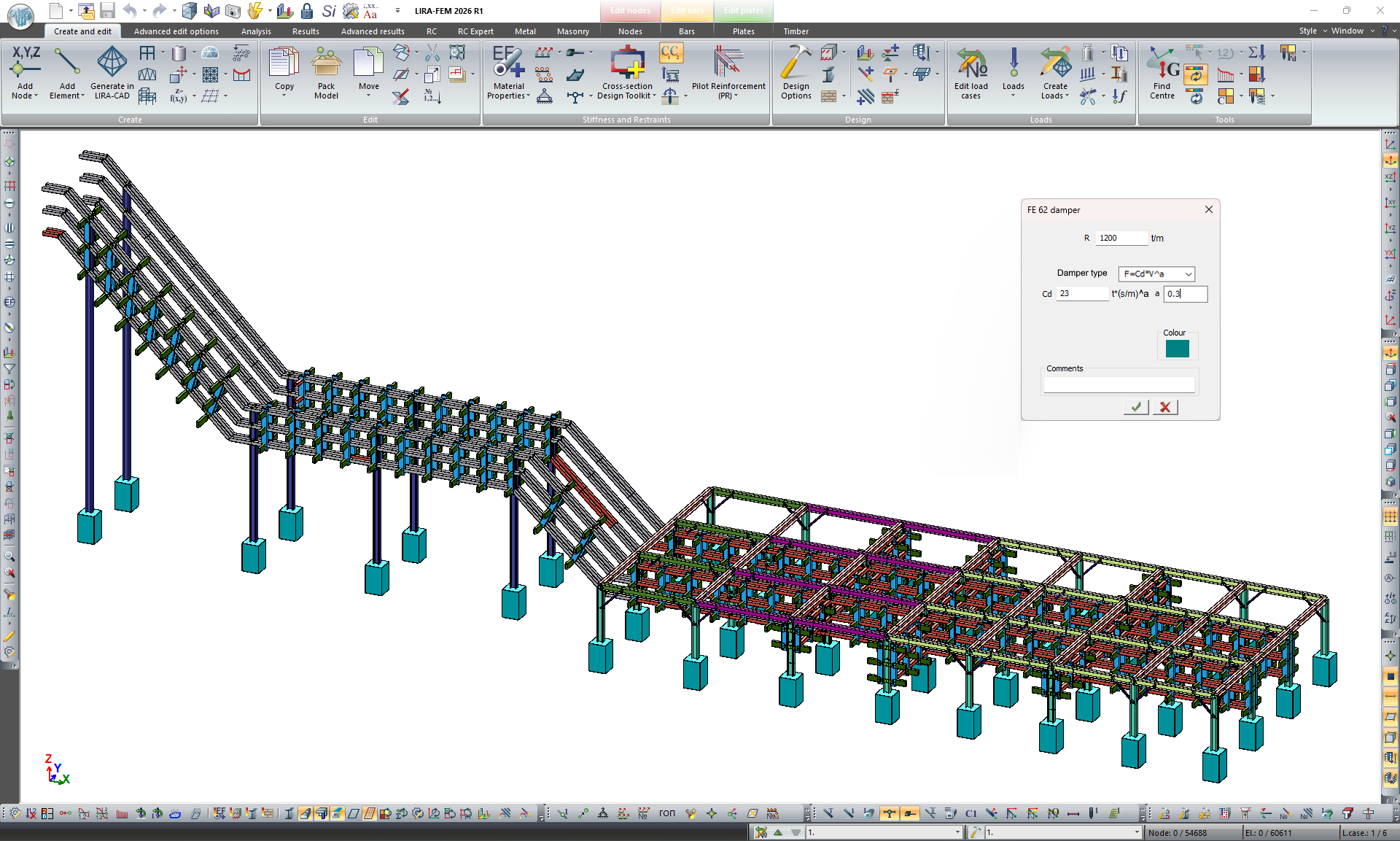
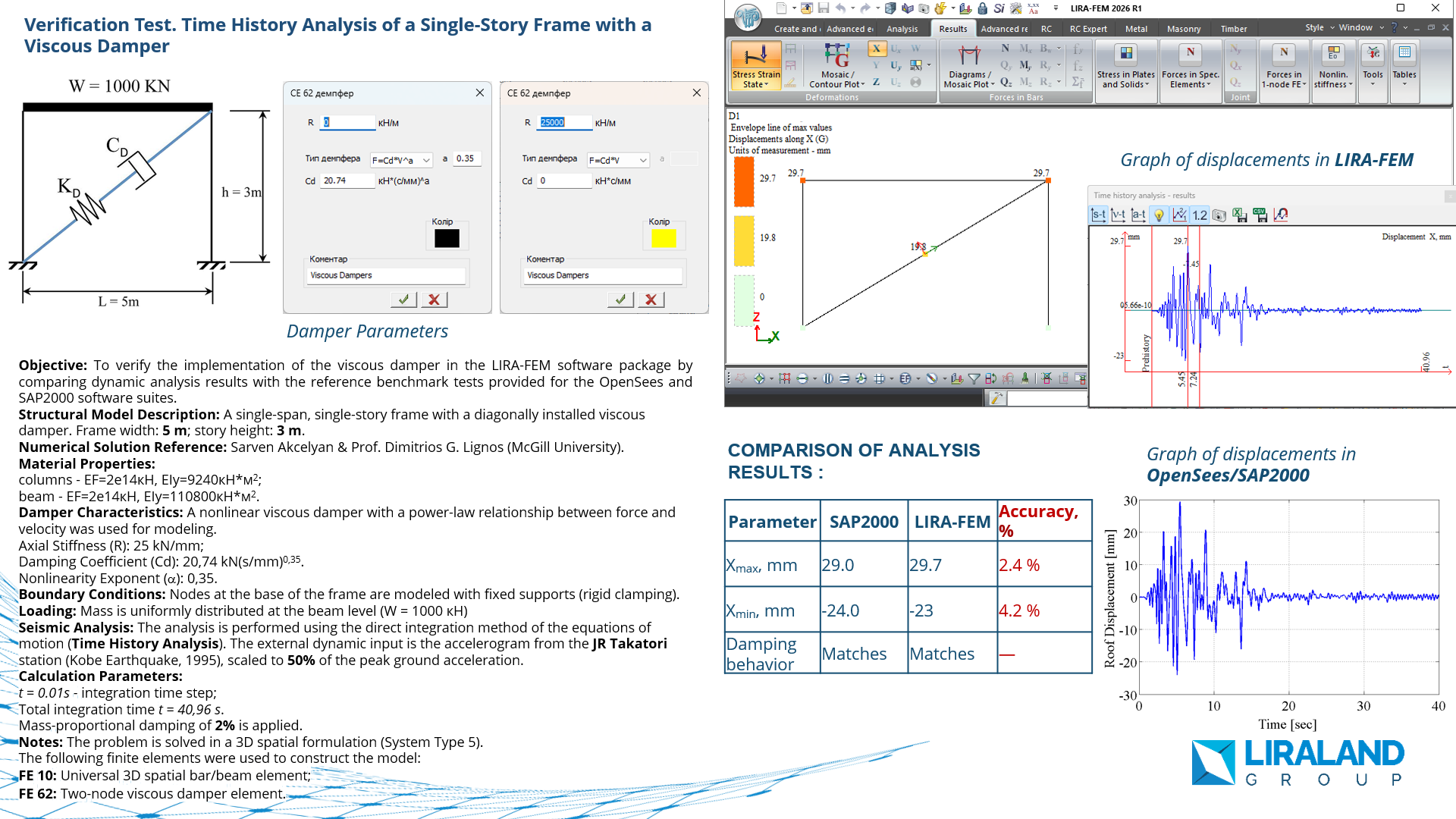
For damper FEs (65/66 and 62), a nonlinear (power-law) dependence of damping force on velocity has been implemented, allowing modeling of damping devices with realistic response characteristics. Calculation of forces in them has been implemented.
Additionally, for damper FEs 65/66, the power-law dependence of force on velocity is implemented not only separately for different directions but also for vector sums X+Y and X+Y+Z. This allows accounting for damper behavior during complex spatial node displacements, when the resulting velocity is formed by multiple motion components.
-
Implemented the modal superposition method, designed for calculating the dynamic response of structures to seismic and other dynamic loads. Compared to direct integration, it significantly reduces calculation time by using the most significant vibration modes while maintaining high accuracy.
To further increase solution speed, Ritz vectors can optionally be applied, ensuring selection of dynamically important modes in system response and allowing more efficient consideration of load effects with fewer calculated modes.
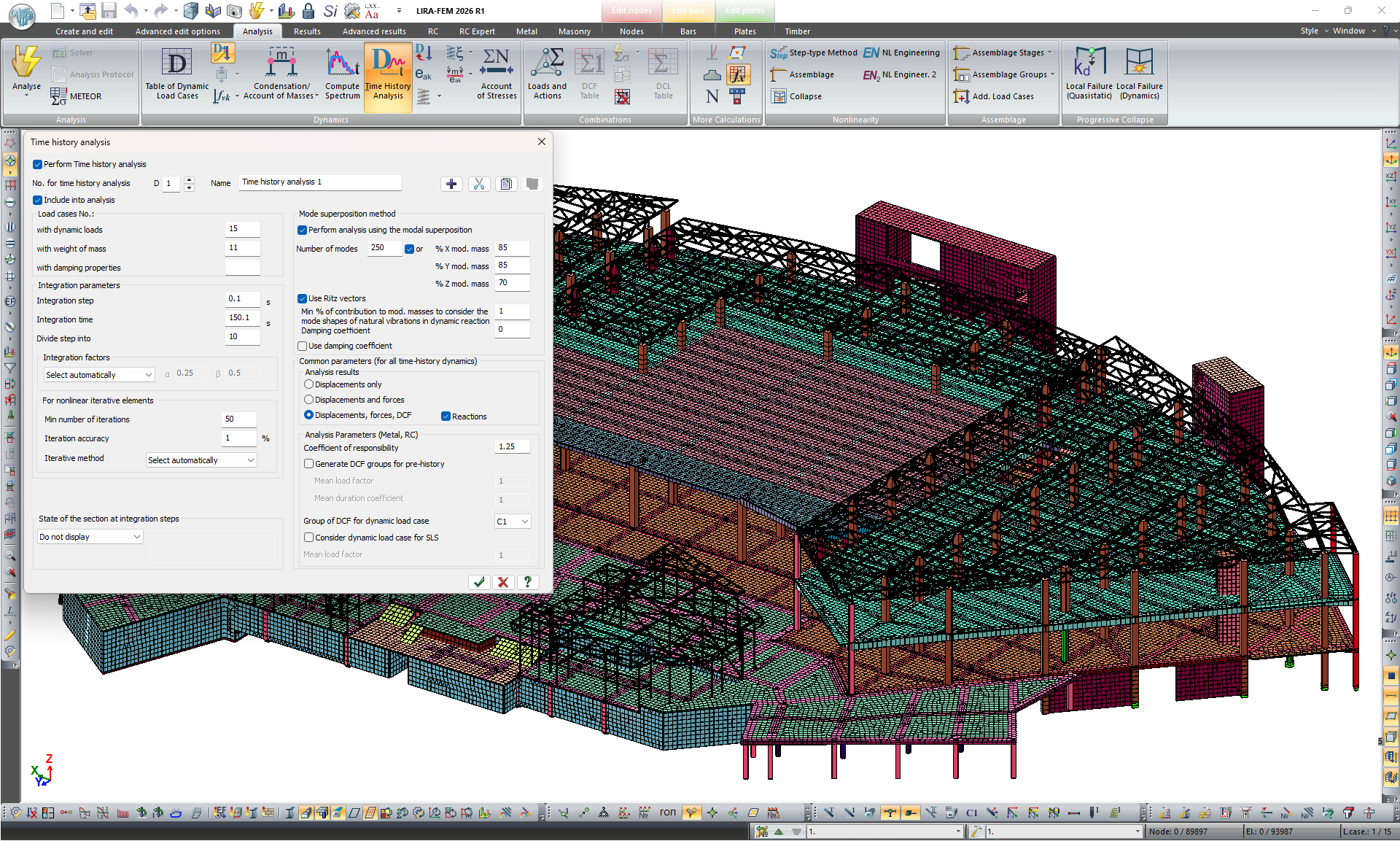
- For problems with time-history analysis (direct integration of motion equations), selective consideration of element masses has been implemented. This function allows refining mass collection for loads with dynamic weights, excluding specific elements when calculating inertial forces/loads.
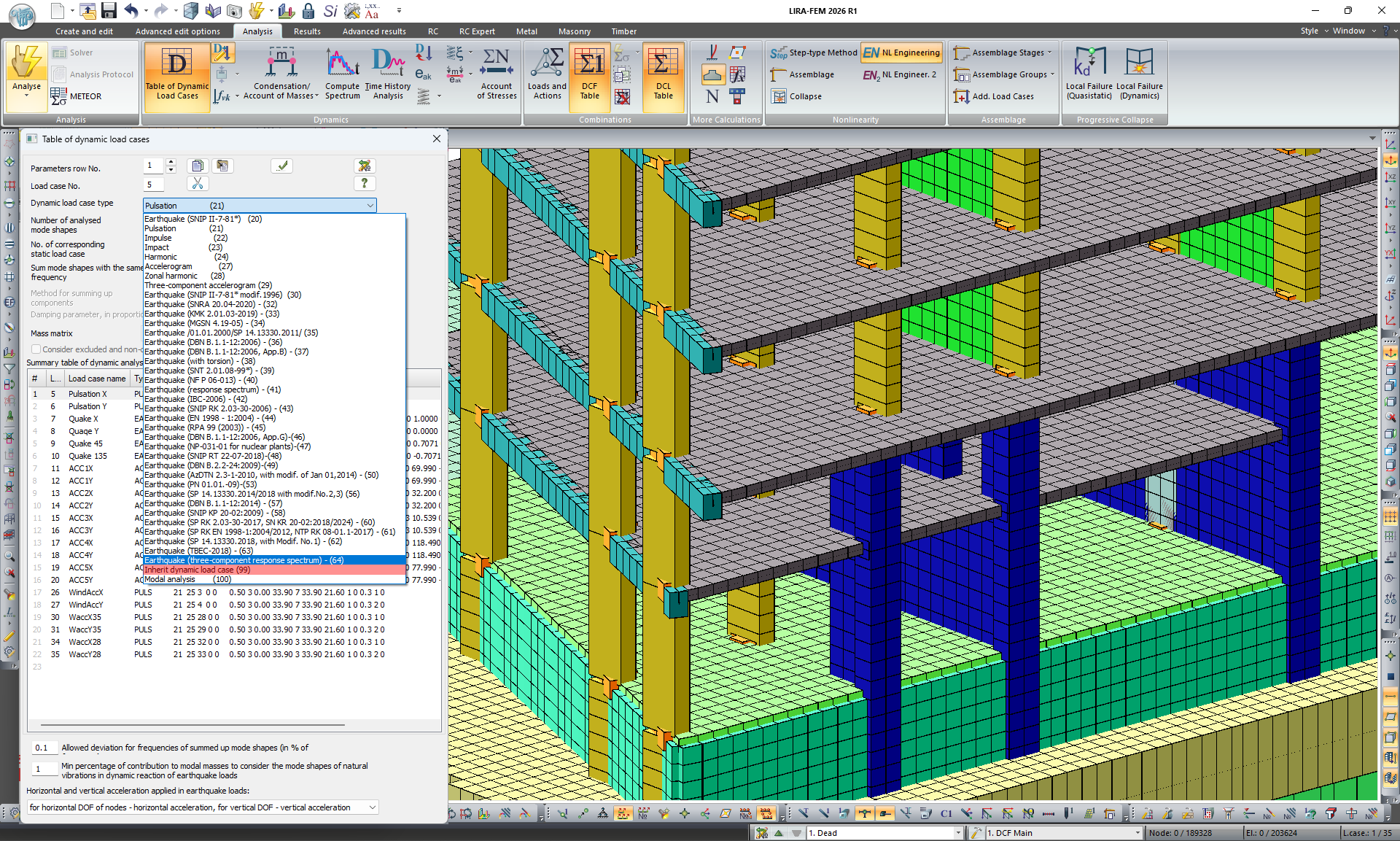
- Implemented a new dynamics module (99) — Dynamic load inheritance. The calculation can be used, for example, to compute vibration modes and inertial forces on a rigid base (in a load case with stiffnesses from one Subtask), and then compute displacements and forces on a flexible base (in another load case with stiffnesses from a second Subtask).
- Added an algorithm for building nodal response spectra based on results of impact calculation on a 3-component accelerogram (dynamics module 29).
-
In the ReSpectrum module, capabilities for considering dynamic properties of multilayer soil thickness when transferring accelerograms between different foundation levels have been expanded. Added dependencies of shear modulus G/Gmax and damping on shear strain level for different soil types.
This allows accounting for changes in soil stiffness and energy absorption depending on seismic impact intensity.