

VERSION HISTORY
LIRA-FEM
- Mass redistribution
- Damping ratio
- Seismic isolators
- Pushover Analysis
- Finite element "Joint"
- New types of perfectly rigid body (PRB)
- Nonlinear behaviour of soil
- New type of force
- Nonlinear custom cross-sections
- Accounting for orthotropy
- Analysis parameters
- Analysis of reactions
- Stresses and forces
- Dynamics
- Nonlinearity
- Finite elements
- Calculation and Performance
RC Expert
-
The RC Expert module is now integrated into LIRA-FEM. This allows performing alternative verification of reinforced concrete elements directly within the LIRA-FEM environment.
The tool provides a full cycle of working with expert data: creating input data, assigning them to finite elements, running checks, and convenient viewing of analysis results. Specialized commands are available for the user, mosaic plots for input data control, viewing internal forces, displaying verification results, and tracing utilization factors.
The system supports working with design problems, property sets, calculation materials, types of design objects, and design options. This enables engineers to use familiar logic when working with the calculation model while expanding the possibilities for reinforced concrete verification.
The tracing routine option allows detailed evaluation of each stage of analysis, ensuring high transparency and reliability of results.
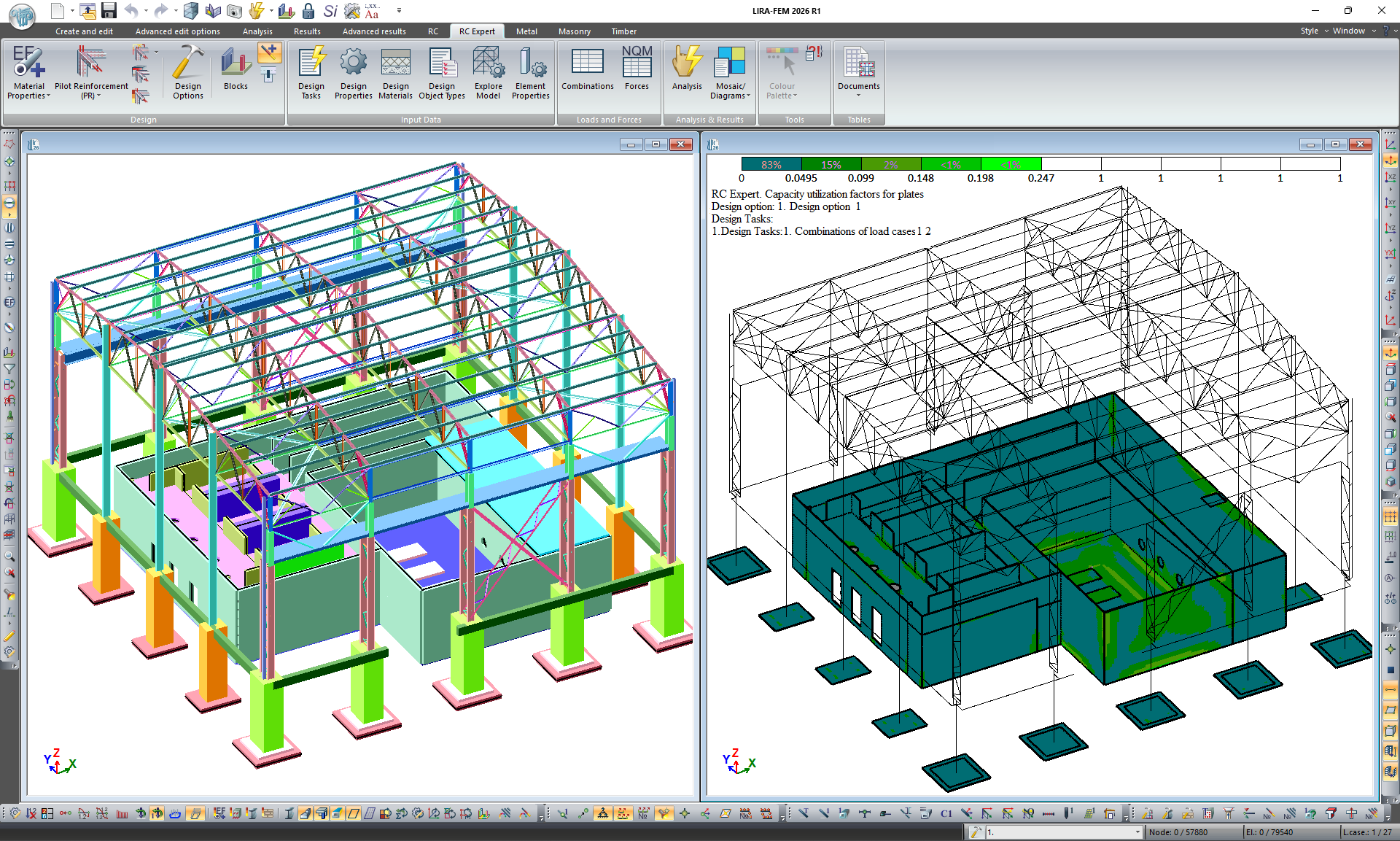
- Added new parametric profile shapes for modeling concrete in bar elements: symmetric and asymmetric T-sections (flange up and down), I-beam, channel, box, circular tube, angle. Support for these new shapes has been added in existing checks for normal section strength and crack resistance.
-
Added new types of checks for bar elements: shear force and torsional moment according to EN 1992-1-1:2004+A1:2014, DBN V.2.6-98:2009.
New checks consider the actual arrangement of transverse reinforcement bars, allowing analysis of the contribution of individual bars to structural capacity — this enables modeling of irregular or locally damaged reinforcement.
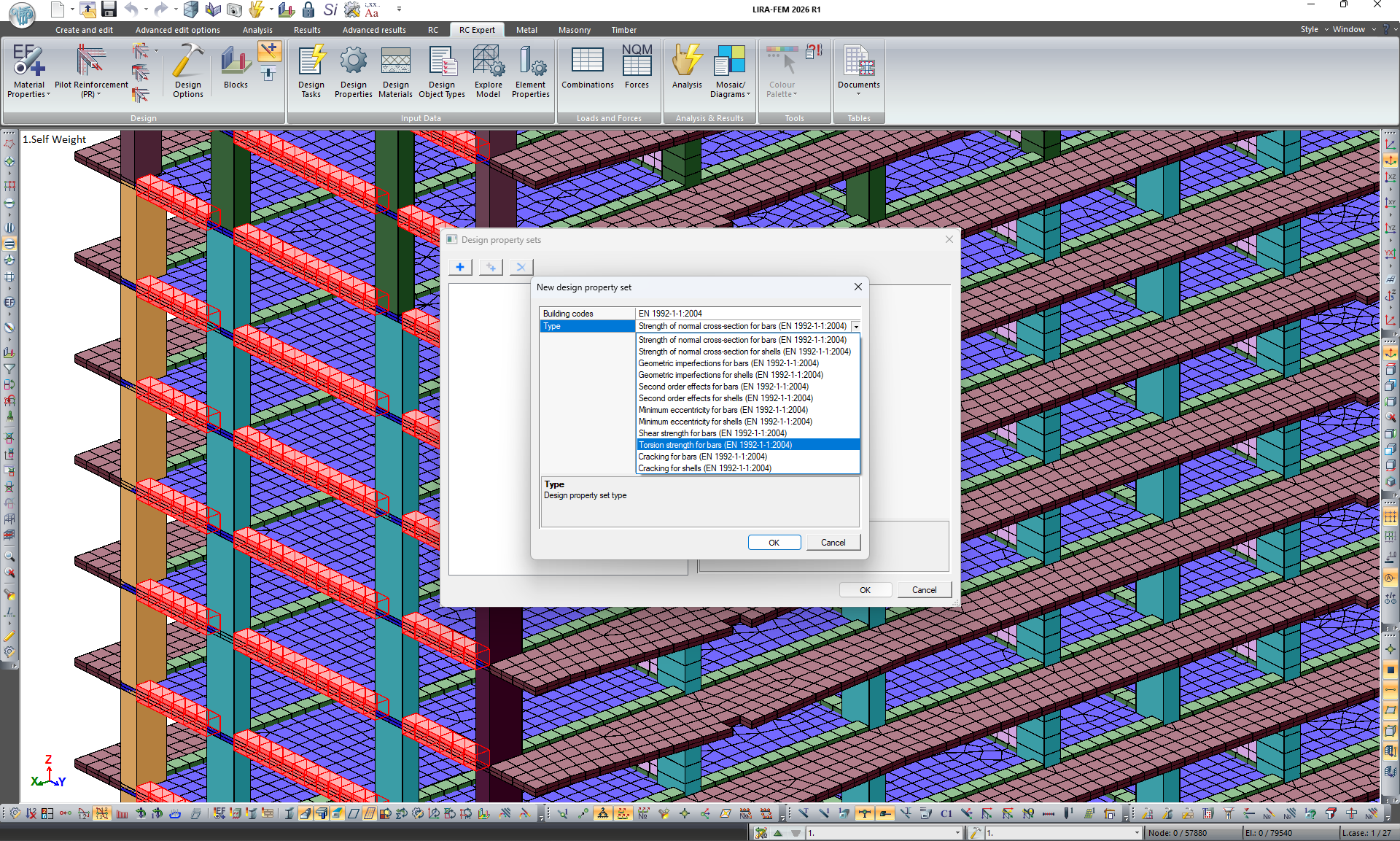
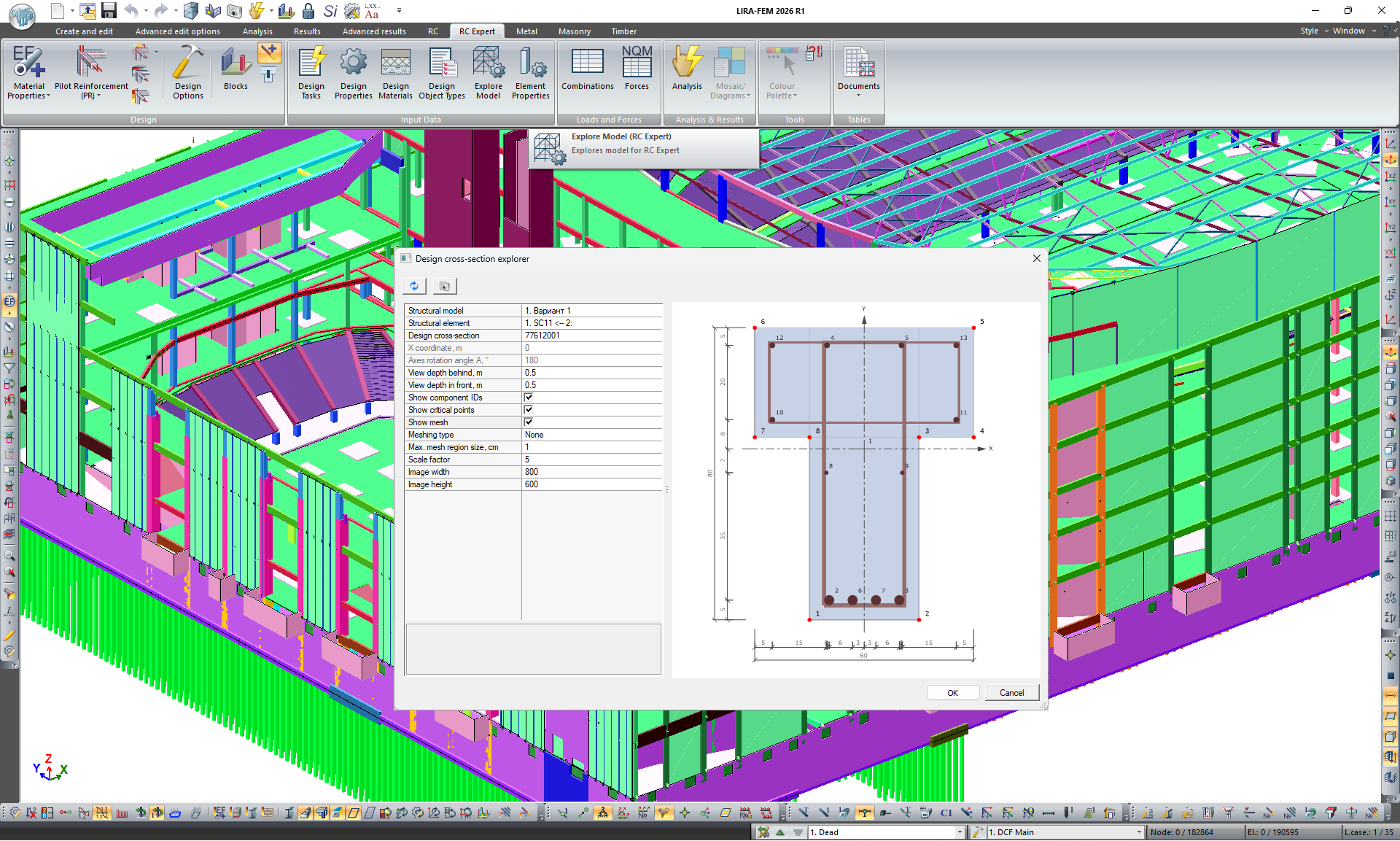
- Improved user interface for input data assignment. Added a new dialog Overview of calculation sections, which allows displaying the composition of the selected cross-section of the structure.
RC Expert
-
For the DBN V.2.6-98:2009 and EN 1992-1-1:2004/A1:2014 standards, a verification of wall and slab elements has been implemented based on the strength of normal cross-sections and crack resistance.
Reinforced concrete expertise
RC Expert is a new system in LIRA-FEM program. It is designed to check the reinforced concrete (RC) structures for strength, serviceability and structural requirements. The system offers additional (parallel to the already existing in LIRA-FEM program) technology for analysis of RC structures, focusing on the needs of a wide range of users: designers, experts, researchers.
This system is mentioned to provide a set of checks according to various building codes, where both the analysis algorithms and the input data can be flexibly customized; and more detailed information, including the tracing routines, can be obtained for the certain analysis results. In the first version of the system, structural elements with arbitrary reinforcement pattern and, in the future, with arbitrary cross-sections and/or with strengthening will be analysed. To capture more design situations not covered by the building standards, the analysis algorithms are highly generalised. If generalisation is not possible, the user will receive information on why the modelled structural solution does not fit into the zone of allowed situations according to certain building code.
Arbitrary reinforcement pattern implies that it can be arranged randomly in space, and the user could define various design parameters for individual reinforcement bars or groups of rebars. This will make it possible to analyse the structural elements with defects, corrosion of reinforcement, strengthening during reconstruction, composite reinforcement, etc.
The user could adjust the analysis procedure:
- to select the list and sequence of certain checks, to customize the check procedures, to consider optional items of the building codes;
- to select a list of elements to be checked and a set of valid force combinations for every check;
- to reassign design parameters and coefficients involved in the analysis with user-defined values to control the analysis procedure.
The required transparency of the analysis procedures for the user is ensured by detailed explanations of the methods and assumptions used in the analysis.
The tracing routine is used for a more thorough evaluation of the analysis results in a certain check for a particular combination of loads. By using the tree of intermediate values, the user can follow the steps taken to extract the intermediate values from the input data; the calculation formulas applied in the program code are displayed.

The file is interactive in contemporary browsers; click the line containing a value to reveal the line contents, which include a formula and a list of input values. And so forth, until the user reaches the desired value.
The first release 2025 R1 will implement the strength checks of the bar structural element of rectangular and circular cross-section by the ultimate and serviceability limit states according to DBN B.2.6-98:2009 and EN 1992-1-1:2004/A1:2014, namely:
- check of the normal sections for in axial force and bending moments using a nonlinear deformation model;
- check of crack resistance in normal sections.
Checks for other internal force components, checks using the ultimate force approach, and checks for plane reinforced concrete (RC) elements will be included to this system in subsequent releases.