VERSION HISTORY
LIRA-FEM
Analysis Options
Analysis and performance
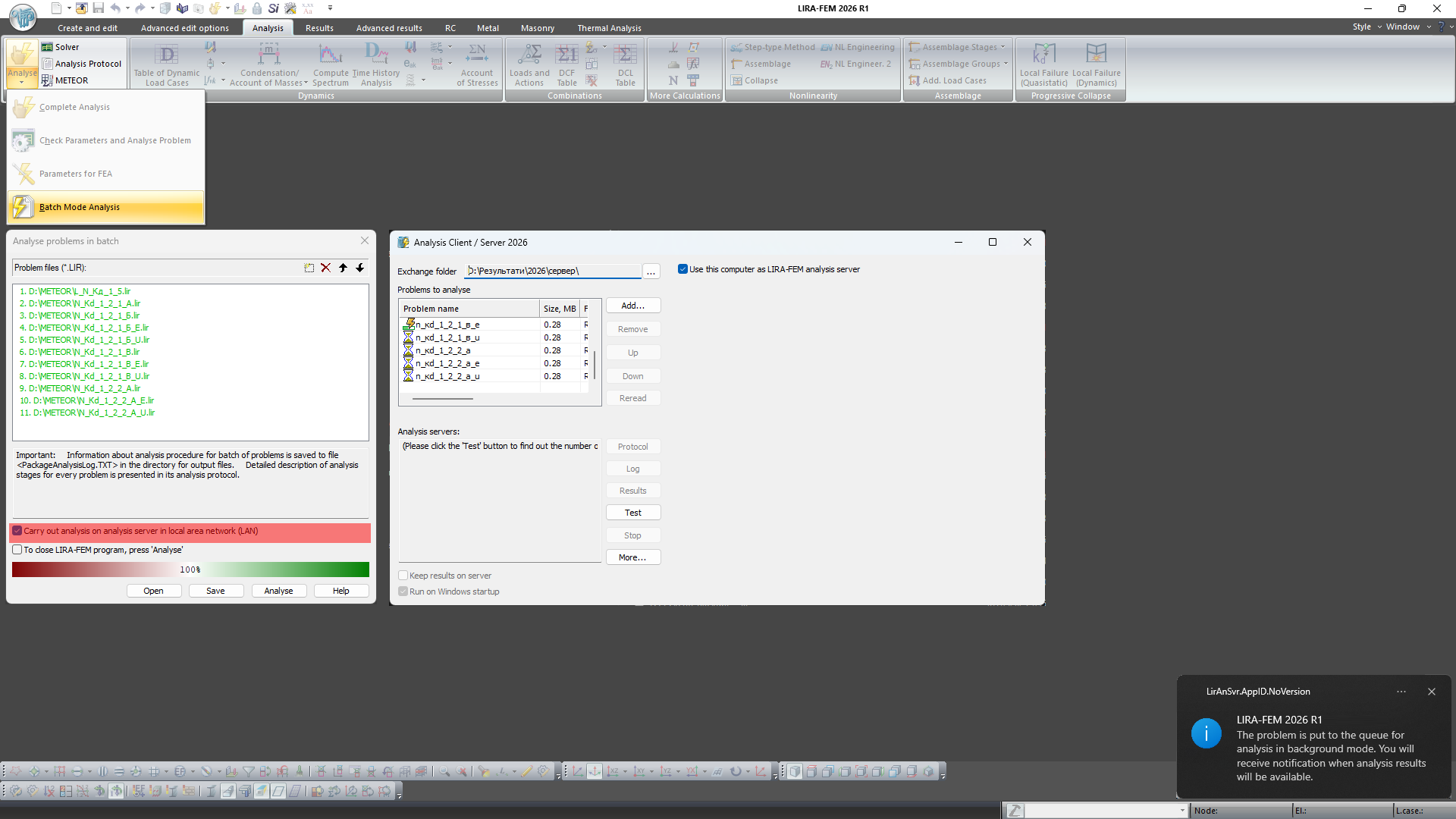
- In the Analyse problems in batch dialog, the ability to add files in groups has been added, as well as the option to interrupt the analysis of the problem list by pressing the ESC key.
- An option for analysis over a local network (LAN) has been added: when selected, the generated problem list is automatically saved with all related settings and sent to the analysis server queue.
Finite elements
-
Modified the operation of thick plate and shell FEs. MITC3 and MITC4 are plate elements with enhanced accuracy for the analysis of thin and thick structures.
Thanks to the Mixed Interpolation of Tensorial Components (MITC) technology, such finite elements reduce the effects of shear locking and membrane locking, providing more reliable displacements, forces, and stresses even on coarse and irregular meshes.
- Expanded functionality for defining plate stiffness: detailed assignment of coefficients (modifiers) for membrane stiffness (X, Y, XY), bending stiffness (X, Y, XY), and shear stiffness (XZ, YZ) with automatic recalculation of the stiffness matrix, including for orthotropic forms.
-
Refined consideration of shear in the geometric stiffness matrix of the bar element.
Nonlinear analysis
- Modified the general algorithm of nonlinear iterative analysis. Updated accuracy criteria and iteration control logic which reduces the number of inefficient iterations and shortens calculation time.
- Diagrams for behavior of nonlinear elastic restraints (FE 295/296) can now be extended to ordinate 0, thus modeling failure/deactivation of restraints.
- Modernized the operation of iterative bar and plate FEs within the nonlinear deformation model, including adjustments to unloading algorithms, force calculations, and consideration of nonlinear material properties.
Dynamics
-
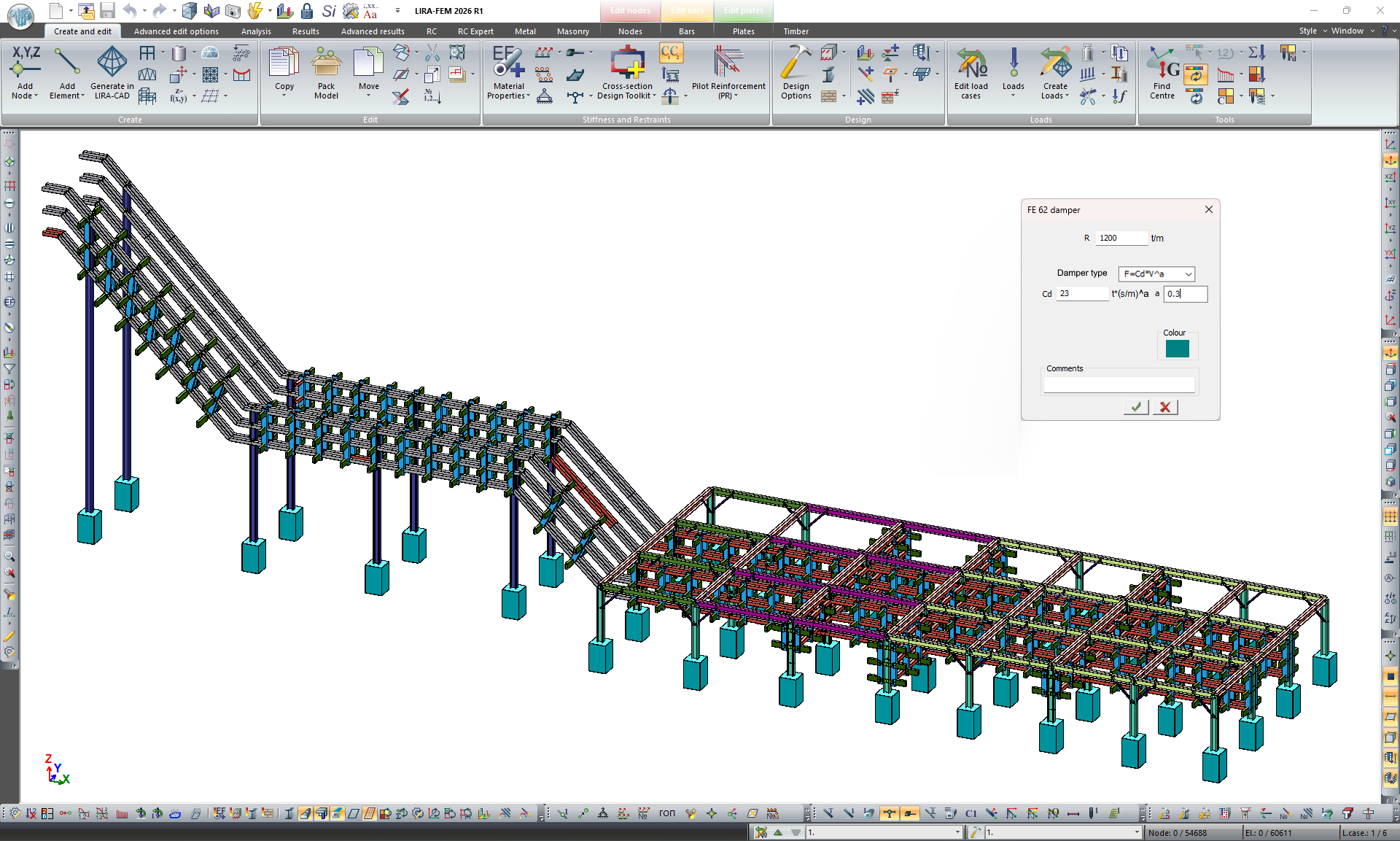
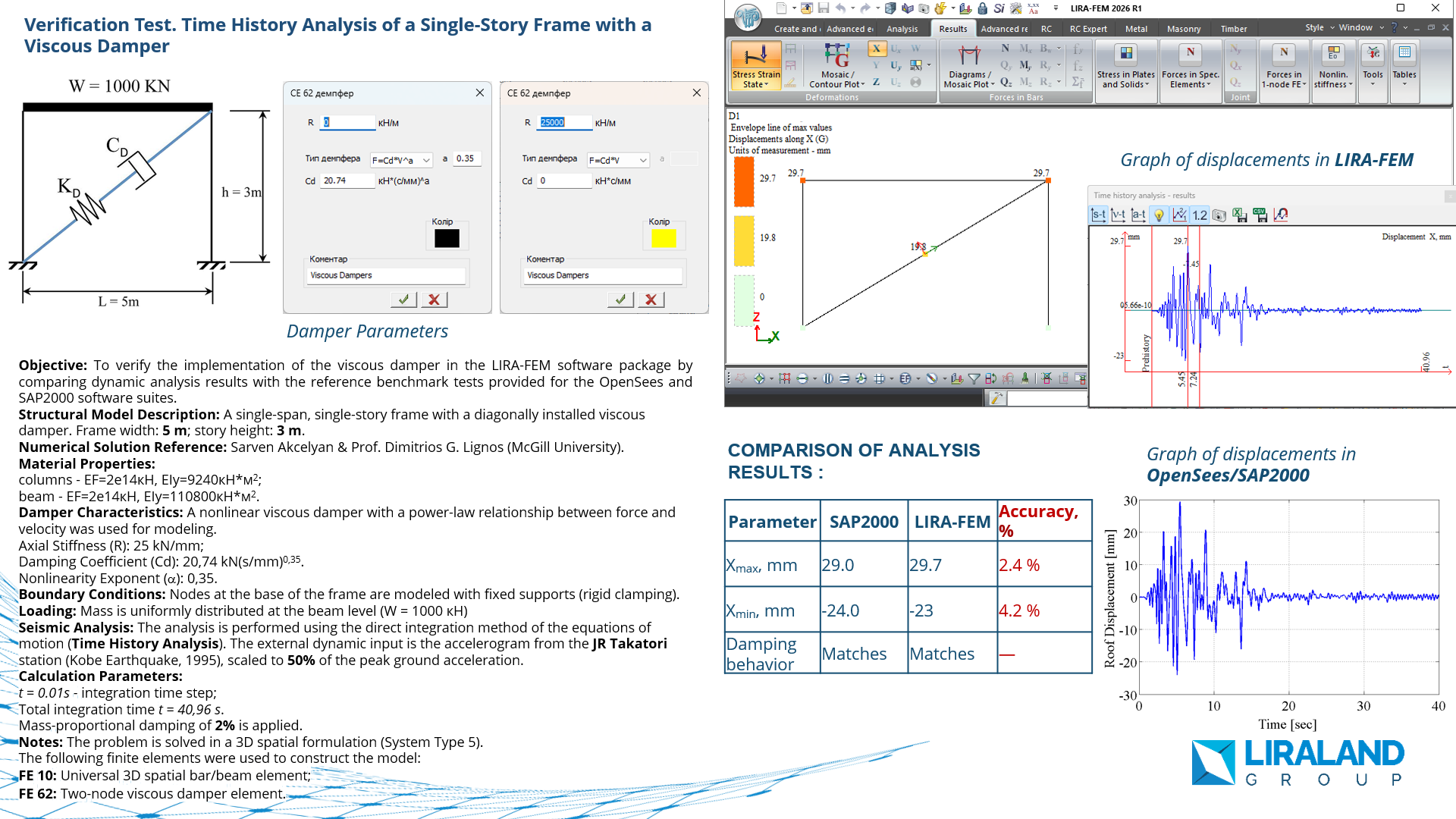
For damper FEs (65/66 and 62), a nonlinear (power-law) dependence of damping force on velocity has been implemented, allowing modeling of damping devices with realistic response characteristics. Calculation of forces in them has been implemented.
Additionally, for damper FEs 65/66, the power-law dependence of force on velocity is implemented not only separately for different directions but also for vector sums X+Y and X+Y+Z. This allows accounting for damper behavior during complex spatial node displacements, when the resulting velocity is formed by multiple motion components.
-
Implemented the modal superposition method, designed for calculating the dynamic response of structures to seismic and other dynamic loads. Compared to direct integration, it significantly reduces calculation time by using the most significant vibration modes while maintaining high accuracy.
To further increase solution speed, Ritz vectors can optionally be applied, ensuring selection of dynamically important modes in system response and allowing more efficient consideration of load effects with fewer calculated modes.
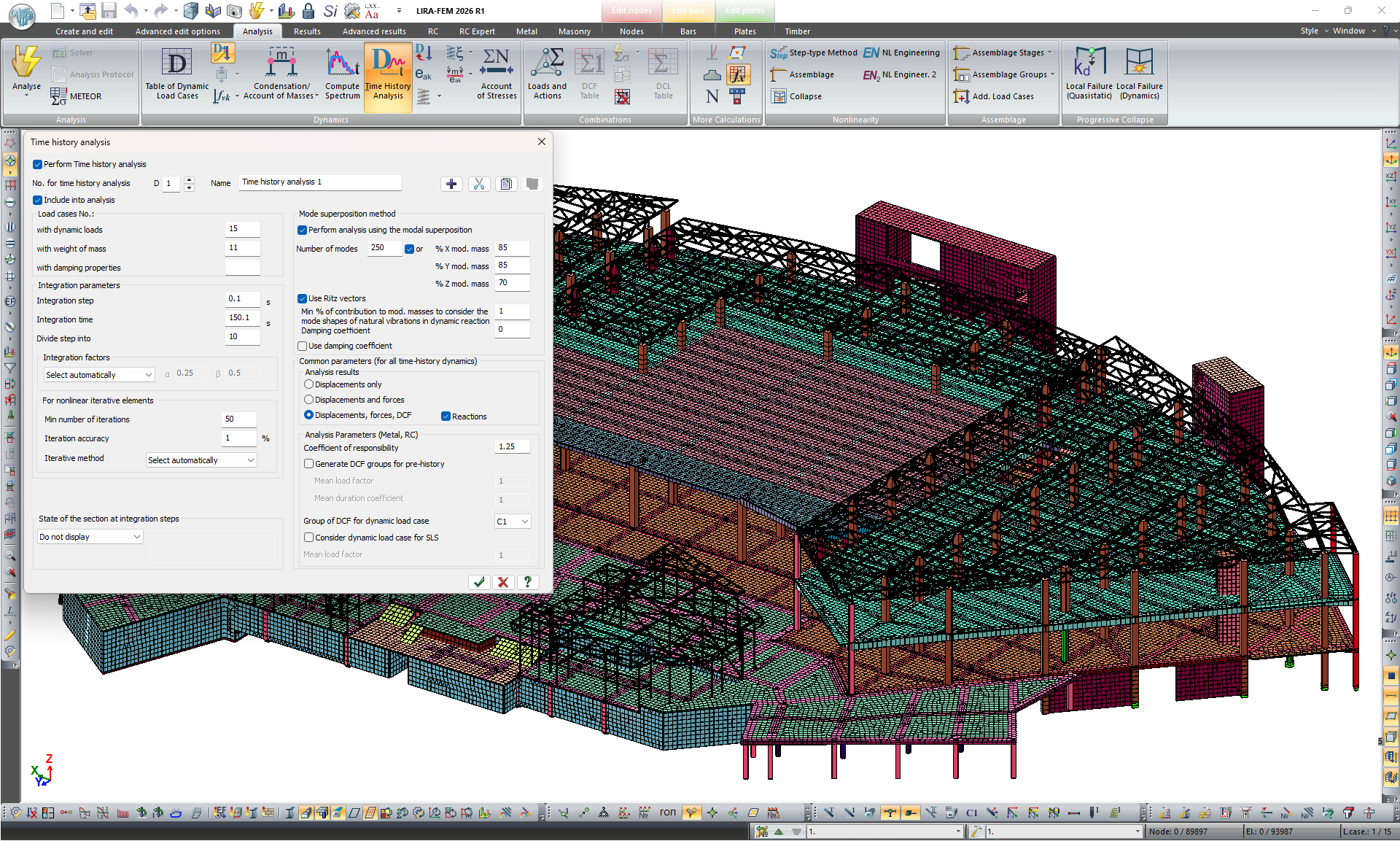
- For problems with time-history analysis (direct integration of motion equations), selective consideration of element masses has been implemented. This function allows refining mass collection for loads with dynamic weights, excluding specific elements when calculating inertial forces/loads.
- Implemented a new dynamics module (99) — Dynamic load inheritance. The calculation can be used, for example, to compute vibration modes and inertial forces on a rigid base (in a load case with stiffnesses from one Subtask), and then compute displacements and forces on a flexible base (in another load case with stiffnesses from a second Subtask).
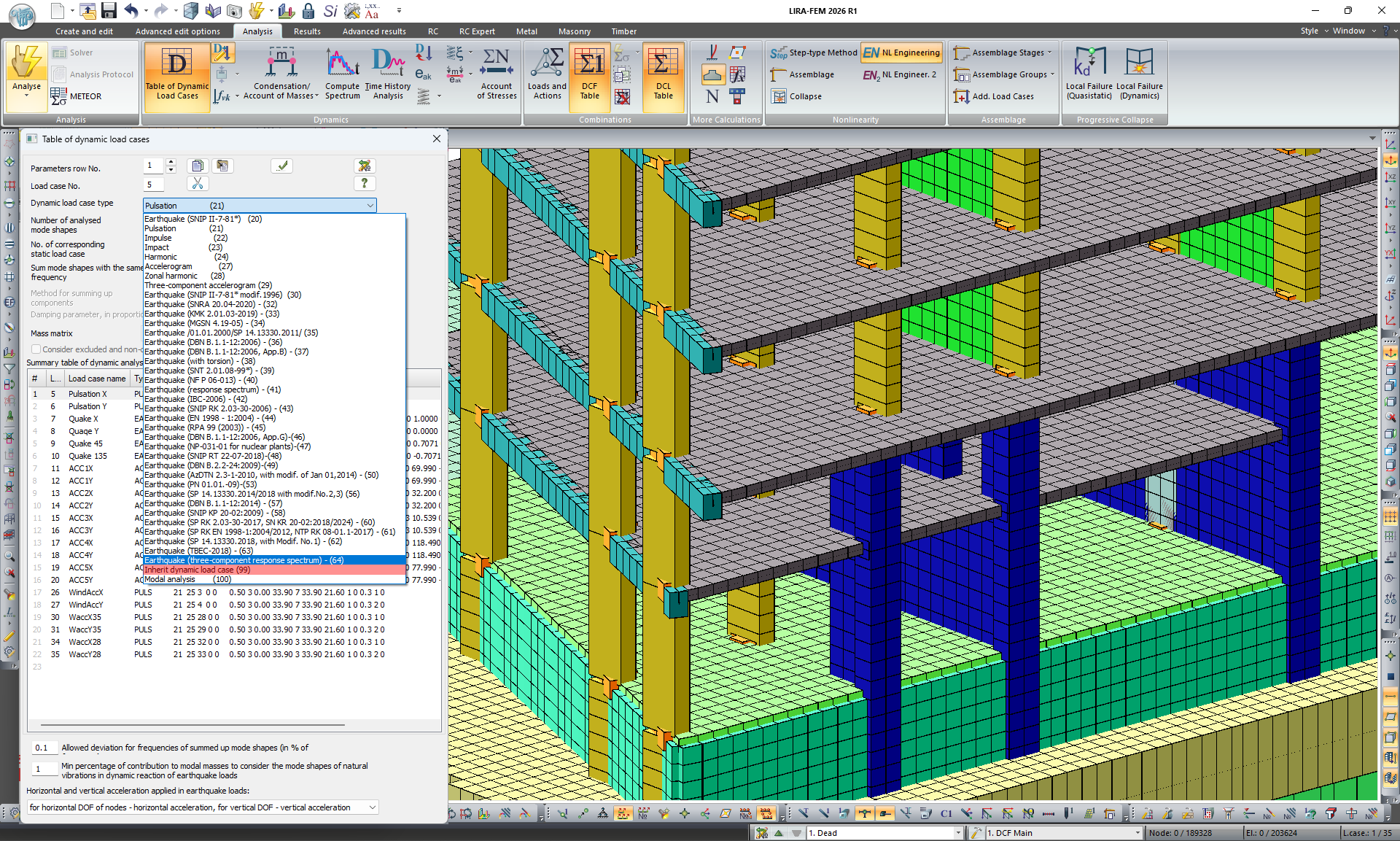
- Added an algorithm for building nodal response spectra based on results of impact calculation on a 3-component accelerogram (dynamics module 29).
-
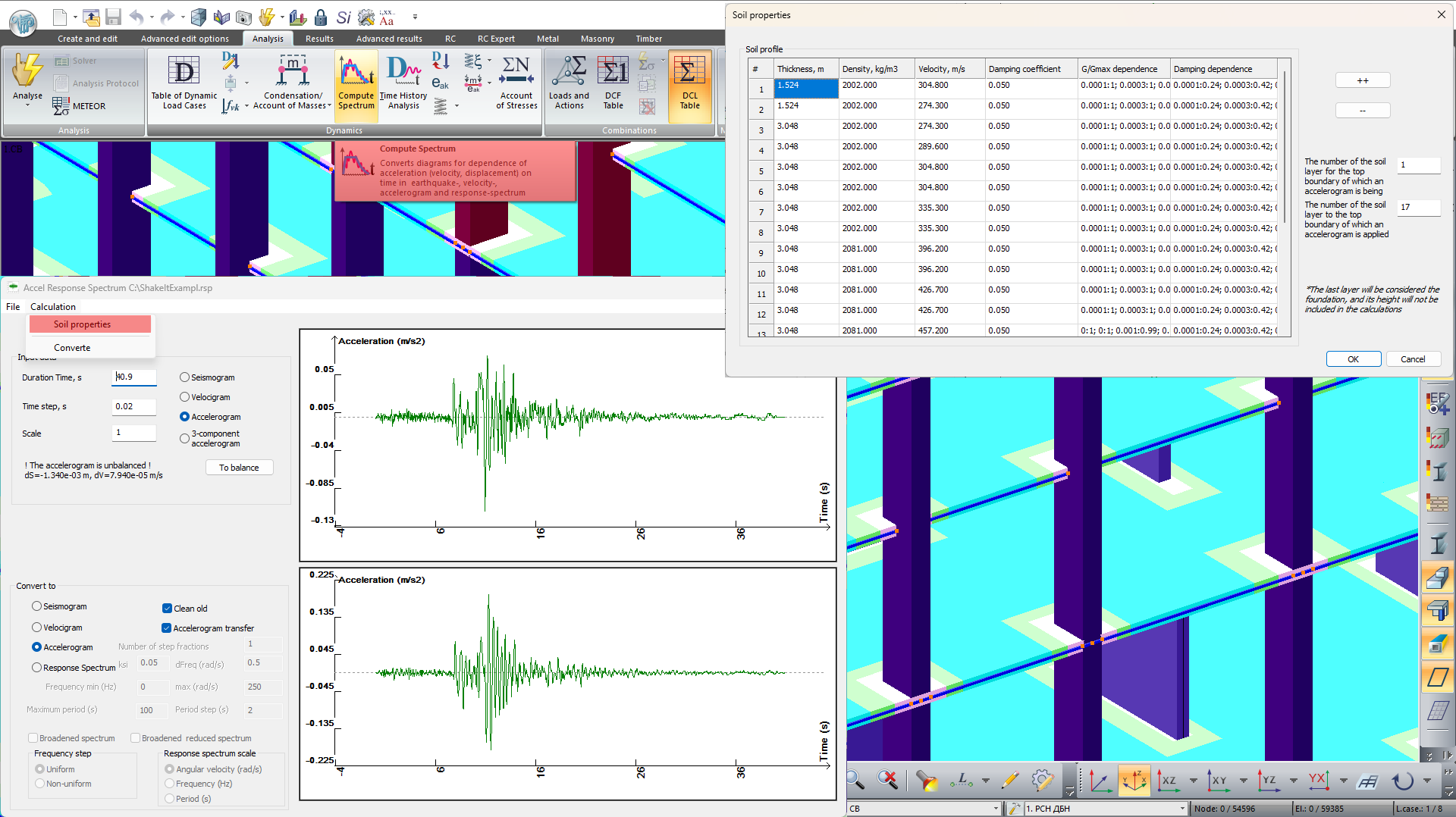
In the ReSpectrum module, capabilities for considering dynamic properties of multilayer soil thickness when transferring accelerograms between different foundation levels have been expanded. Added dependencies of shear modulus G/Gmax and damping on shear strain level for different soil types.
This allows accounting for changes in soil stiffness and energy absorption depending on seismic impact intensity.
Stresses and forces
-
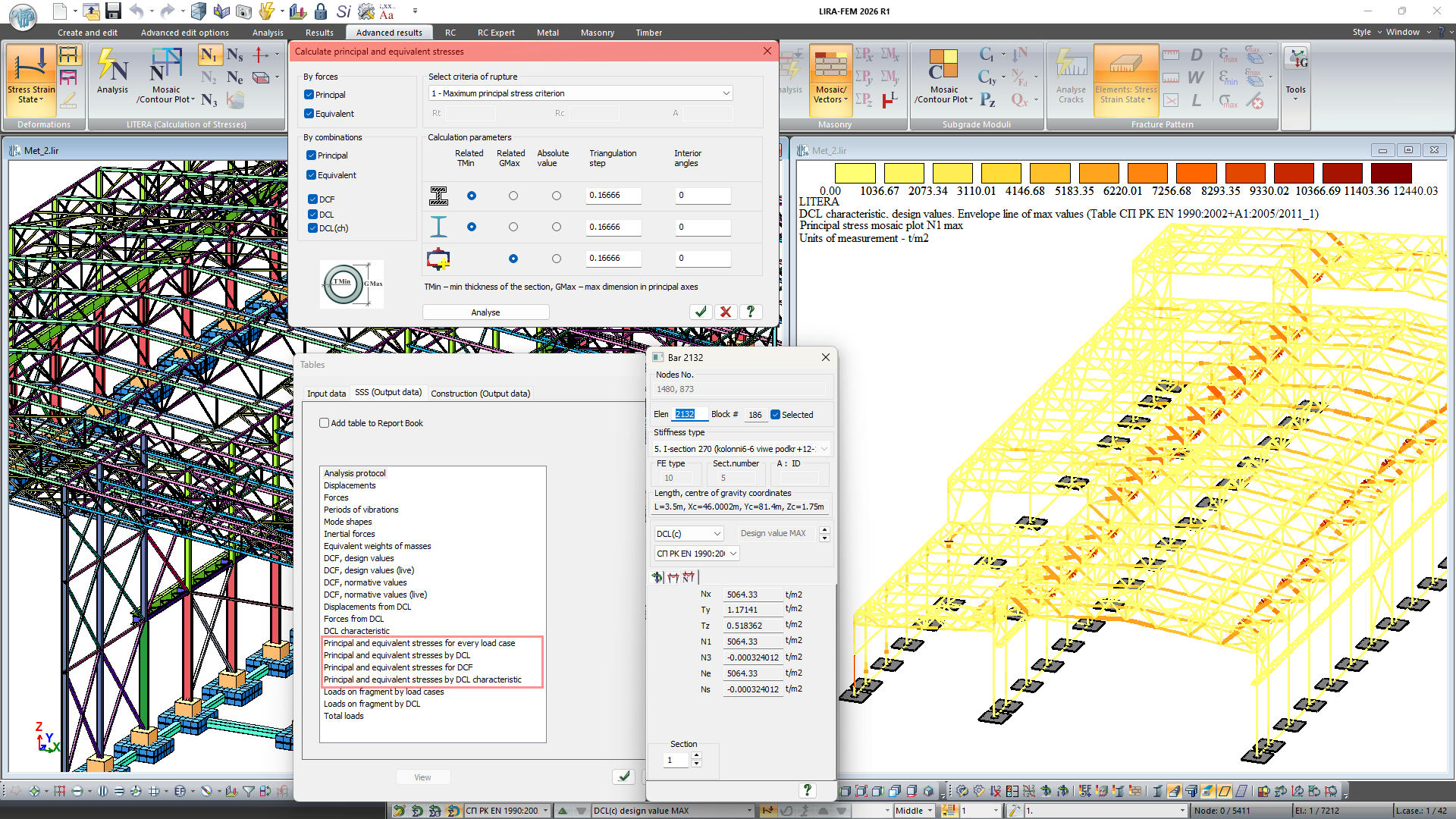
The LITERA system has been significantly expanded and modified. It is designed to compute principal and equivalent stresses in finite elements based on forces from individual load cases, as well as from design combinations — DCL, DCL(c), and DCF.
Previously, calculations were performed for solid elements, plates, and a limited set of standard section types: bar, T-section, I-beam, channel, etc. Now, principal and equivalent stresses are calculated for solid elements, plates, and also in cross-sections of bars for all section types — both standard steel and monomaterial sections of arbitrary shape.
The cross-section is automatically divided into finite elements. Flexible adjustment of the division step is provided: in absolute values or relative — as a fraction of the minimum element thickness tmin or of the maximum dimension along principal axes. Additionally, the option to set an exclusion radius in internal corners of the section has been implemented to avoid searching for critical points in stress concentration zones.
Implemented calculation of principal and equivalent stresses in finite elements based on defining design load combinations.
Integrated the Pisarenko–Lebedev strength theory, intended for the calculation of nonhomogeneous materials. It provides a more accurate assessment of the stress state of materials with different strength limits in tension and compression.
Calculation results are available in both tabular and graphical form.
-
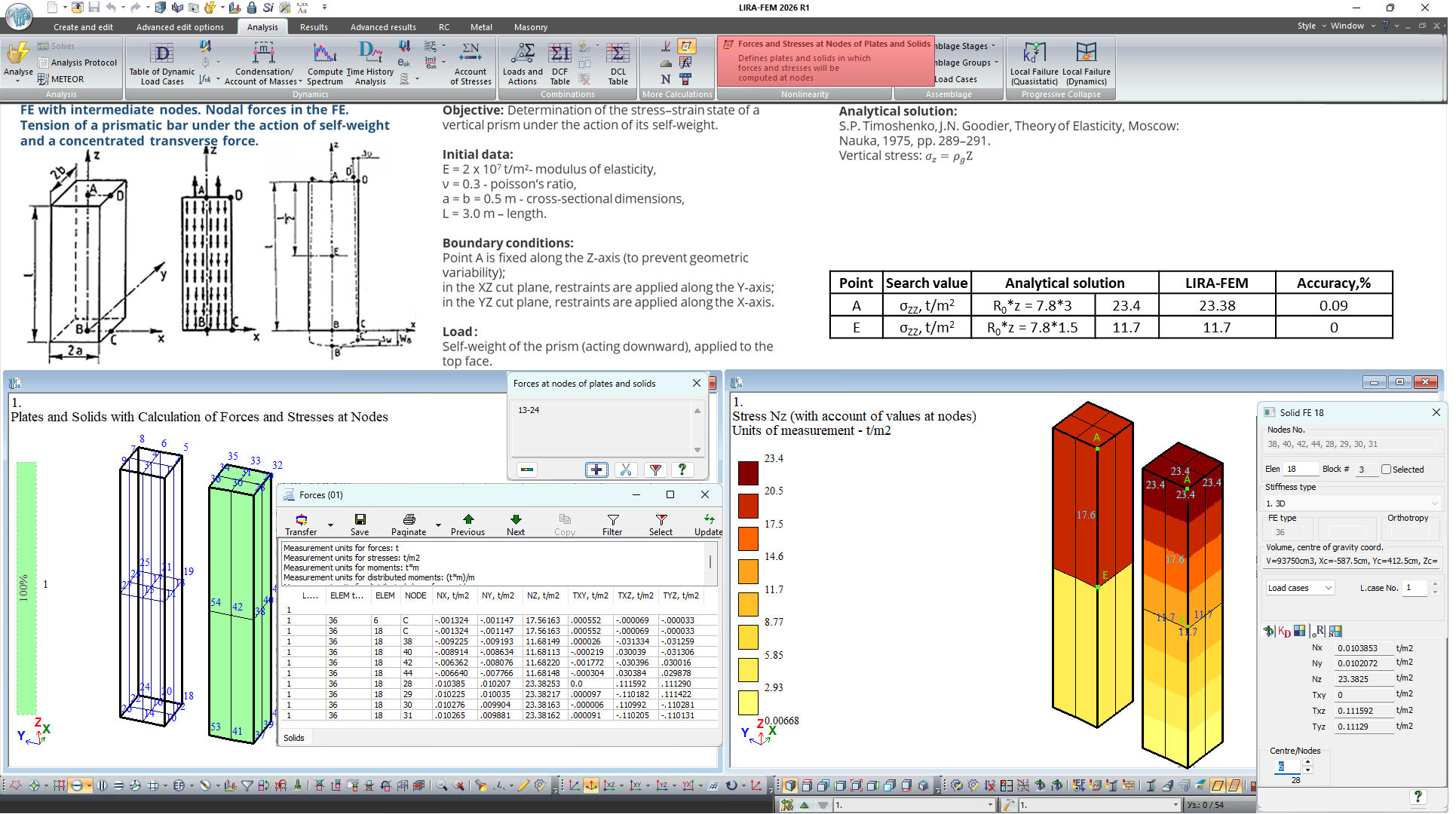
For linear solid FEs, stress calculation at nodes has been implemented. Results are available in both tabular and graphical form. Using this option increases accuracy of stress determination when calculating on a coarse mesh of solid elements, as well as when integrating forces in target plates of plate FEs.
Important note: for calculation of solid FE arrays on a coarse mesh, it is necessary to enable the option of forming additional nodes on edges in calculation parameters. This applies to plate and solid FEs and switches the calculation from classical FEs to high-precision ones.
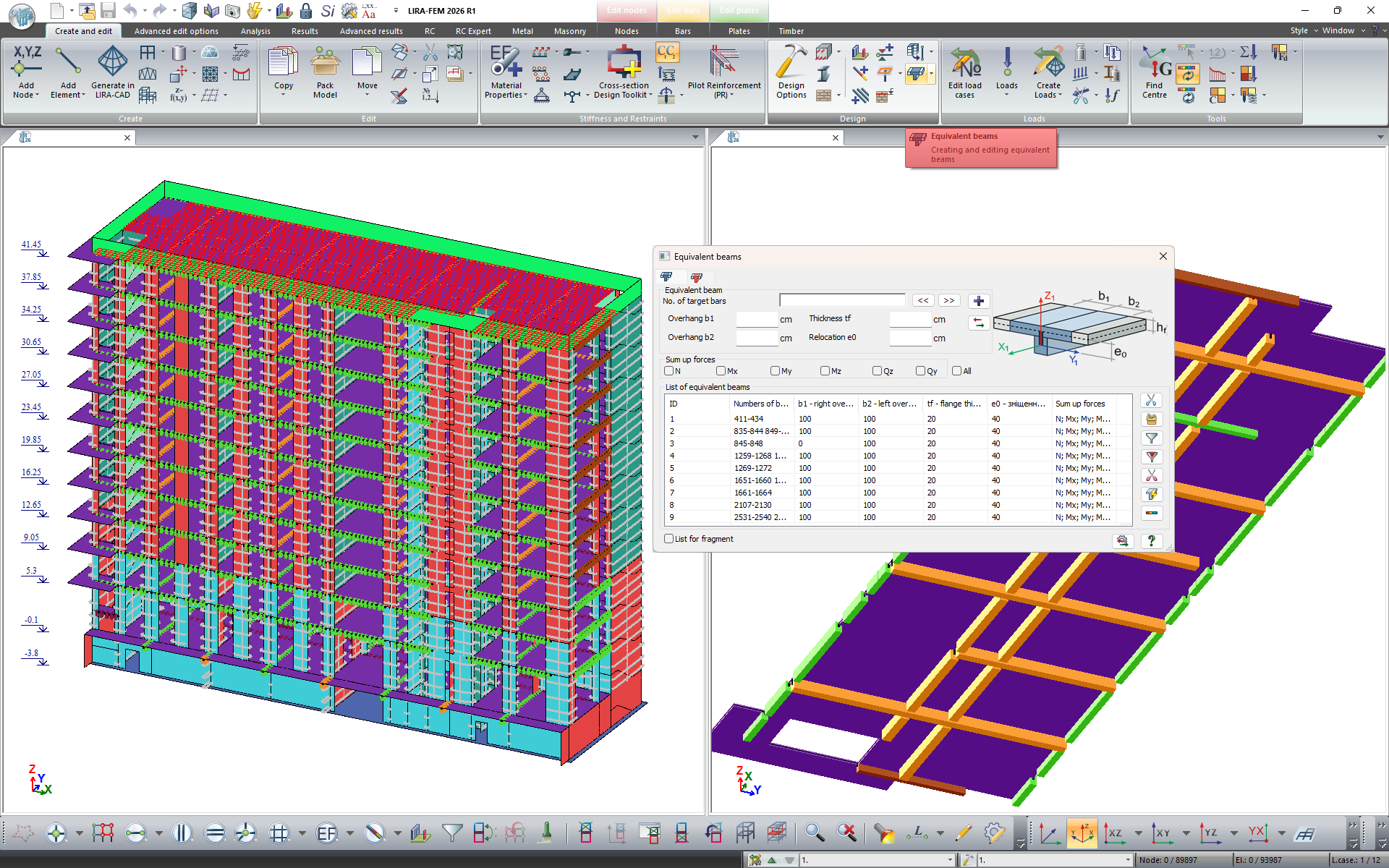
- Implemented calculation of forces in support and tie beams, ribs, and T-beams considering overhang width. Forces are determined according to the model of joint beam–slab action, taking into account the geometry of the formed section, which allows more accurate consideration of element stiffness, distribution of internal forces, and structural deformations.