

VERSION HISTORY
LIRA-FEM
API improvements
In LIRA-FEM 2026, the capabilities of interaction with the system via API have been significantly expanded. To automate routine tasks, generate complex objects, and integrate with external software, LIRA-FEM uses an API based on COM technology.
Key API Features
- Automation of LIRA-CAD: creation of custom nodes for the Generator and development of plugins.
- Input tables: programmatic control of design model data — import, adjustment, and updating via user interface or programmatically using COM technology.
- Reading and visualization: functions for obtaining analysis results and displaying them as mosaic plots, contour plots, and diagrams directly in the model window.
- Versatility: support for any programming languages that work with COM objects: C#, C++, Python, JavaScript (including V8), VBScript, and others.
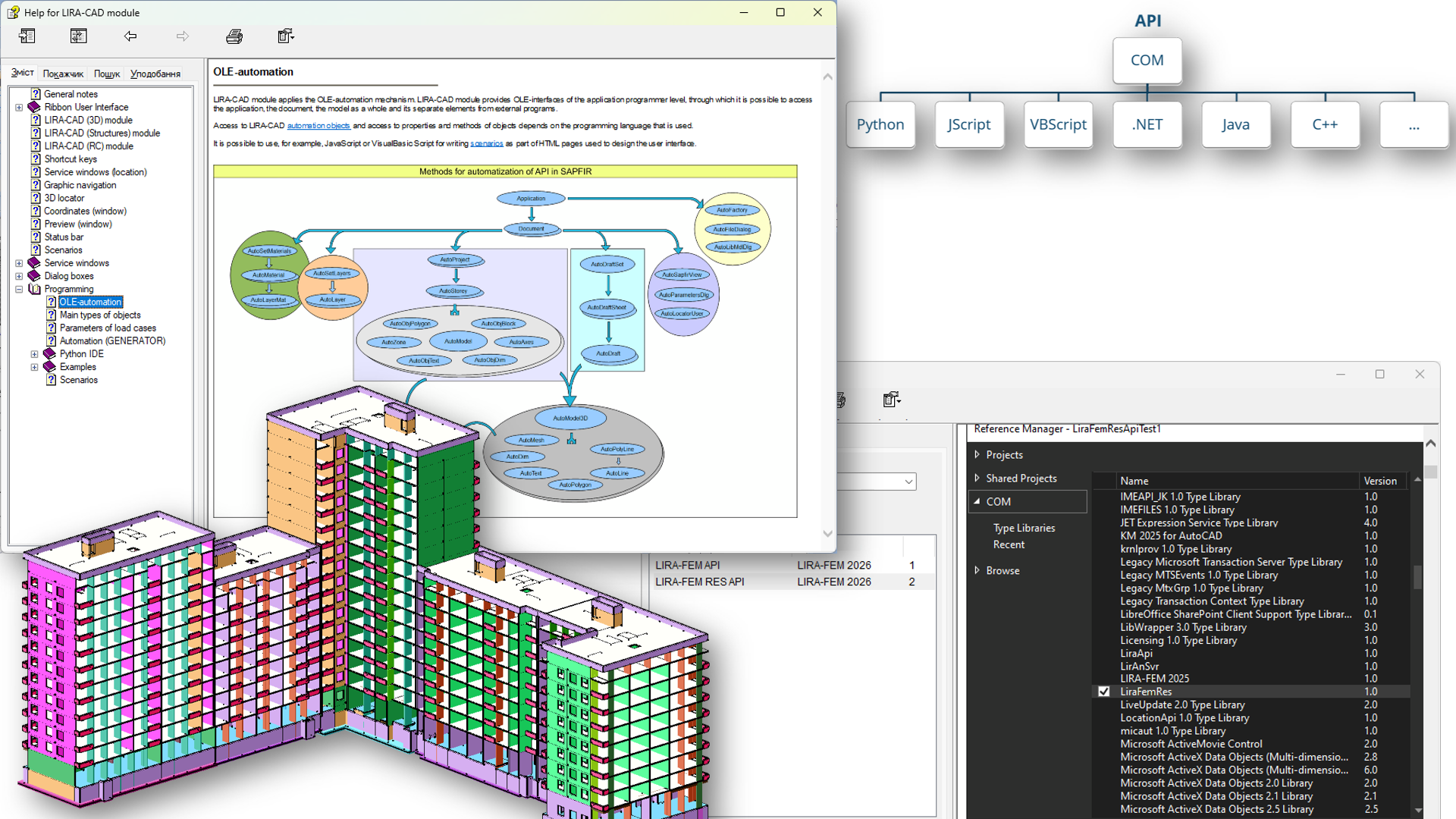
API and input tables
User Extensions
-
The main innovation is loading modules into the address space of the LIRA-FEM process. This gives external developers access to previously closed API functions and allows them to extend the capabilities of the software.
- Interface customization: embedding custom commands and buttons into the LIRA-FEM ribbon.
- Calculation cycle management: introducing custom data into the overall task structure and integrating specific algorithms into the calculation “pipeline.”
- Automated reporting: adding custom sections to the Report Book, including updatable CSV tables and screenshots.
- Development of new modules: a framework has been created for porting applications as LIRA-FEM extensions.
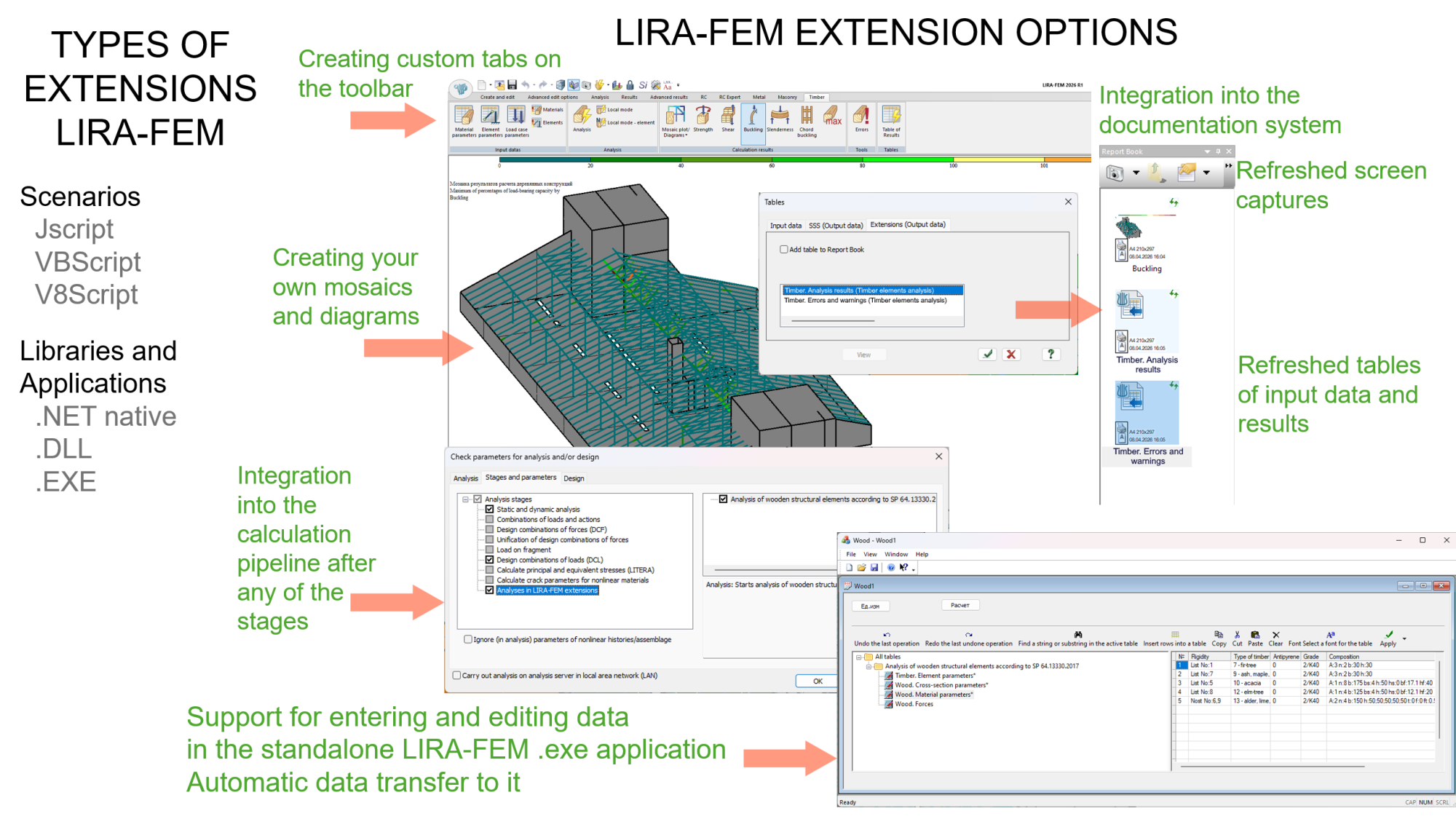
User extensions LIRA-FEM
API LIRA-CAD and LIRA-FEM
-
New input tables have been added for setting and adjusting design model data:
- pile stiffness — FE 57;
- materials for reinforced concrete structures: bars, plates, concrete, reinforcement;
- materials for steel sections: material, additional characteristics, selection restrictions;
- design options;
- DCF table;
- structural elements;
- element unification;
- soil model: basic, collapsible, swelling, saline, permafrost characteristics, consolidation, creep, boreholes.
- For convenience, a tree-like structure of sections has been added, as well as the ability to simultaneously delete, copy, cut, and paste multiple input tables.
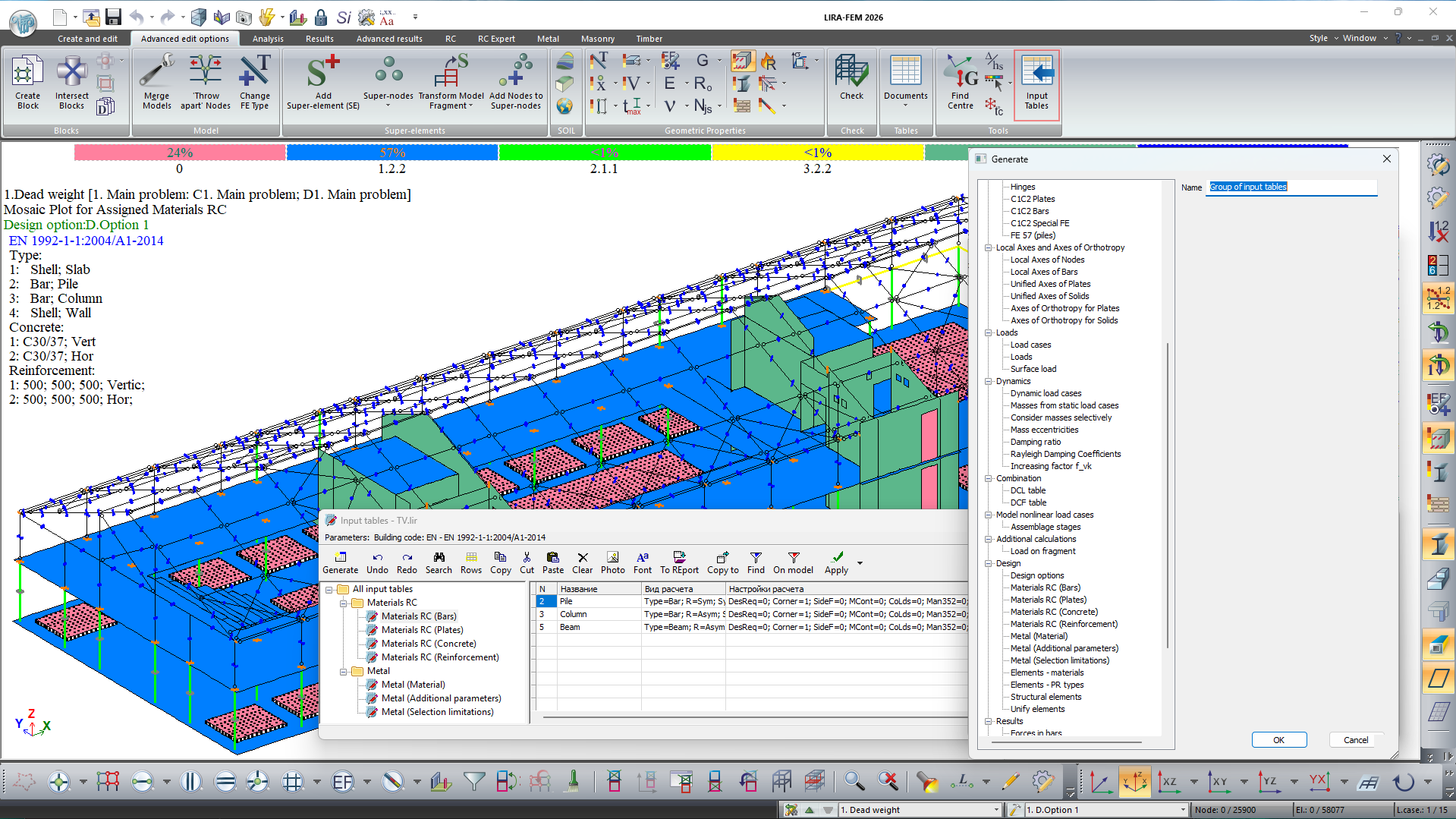
Input tables for creating tables with the ability to directly adjust current task data